

May 5, 2026
This past weekend I found myself in Springfield, Illinois as a guest presenter at the AIAspire Student Leadership Conference, a gathering centered on giving architecture students practical insight into presentation, leadership, career growth, team management and what the profession really looks like behind the curtain. The weekend also included portfolio reviews and a behind-the-scenes tour of the Illinois State Capitol, but for me it unfolded as something more layered, a reminder of why architecture has always been about far more than buildings alone.
I arrived early and began my time in Springfield at the Dana–Thomas House, one of Frank Lloyd Wright’s Prairie School masterpieces tucked along East Lawrence Avenue. I have been fortunate to visit many Wright properties across the country, but this house struck me in a way I didn’t fully anticipate. Designed and built between 1902 and 1904 for Susan Lawrence Dana, a wealthy socialite, philanthropist and civil rights activist, the home is both one of Wright’s earliest residential works and one of the most complete. At roughly 13,000 square feet, it is the third largest Wright-designed residence and remains furnished almost entirely as he intended, from built-in seating and folding tables to delicate bud vases designed to hold dried prairie weeds.
What makes the house remarkable is not just its scale or preservation, but the clarity of intent. Dana gave Wright no budget, an almost unimaginable freedom, and he responded by designing everything, architecture, interiors, furnishings, art glass, down to the smallest details. More than 500 pieces of art glass fill the home, worked into butterfly motifs, chevron patterns inspired by the sumac tree and poetic references like the “flower in the crannied wall,” a nod to Tennyson and to Wright’s belief in the marriage of nature and architecture. The exterior walls themselves are layered with plaster mixed with hemp and horsehair, later painted a patina green to mimic copper, and the eaves lift upward like a Japanese pagoda, subtly directing your eye skyward.
There are moments throughout the house that feel almost radical for their time. It was Springfield’s first home with indoor plumbing and electricity. Every bedroom, including those for staff, had an en-suite bathroom, one of which featured the city’s first stand-up shower stall. Wright introduced running water as a natural element through a sculptural fountain, collaborated with sculptor Richard Bock and incorporated two of only four barrel vaults he ever designed, both found here. Portions of an earlier 1850s parlor were absorbed into the new design, creating a layered architectural palimpsest that somehow still feels singular and resolved. Today, the house is considered the most valuable asset owned by the State of Illinois, insured for $250million dollars, with individual pieces commanding extraordinary value, including a lamp recently sold at auction for $7.5 million.

After Dana–Thomas, I made a beeline to the Abraham Lincoln Presidential Museum. Opened in 2005 and designed with the help of former Disney Imagineers, the museum balances immersive storytelling with historical rigor in a way that feels intentional and generous. I was especially drawn to its interactive components. Springfield is a destination not only for historians and Lincoln enthusiasts, but also for nearly every sixth grader in the state, and I vividly remember my own school trip there at twelve years old. The museum manages to engage that wide spectrum beautifully, offering depth for adults while remaining accessible, tactile and memorable for younger visitors, a reminder that good design meets people where they are.

The following day brought one of the most powerful experiences of the weekend, a personal tour of the Illinois State Capitol led by David Finnigan, Project Architect with the Office of the Architect of the Capitol. Walking the building with someone who understands it from the inside reframed it entirely. We often think of government architecture as purely functional, but David emphasized that it is also deeply cultural, encompassing libraries, theaters and schools, structures meant to endure and serve as shared symbols over generations.

The Capitol, completed in 1870 shortly after the Civil War, was designed to be permanent, an architectural statement of stability and democracy in a fractured nation. Its dome, the tallest of any state capitol in the United States, traces its lineage back through England to ancient Rome, where domes were tied to the idea of the divine. In the American context, early architects reinterpreted this form to represent democracy itself, inclusive, collective and expressive of the idea that everyone has a voice under the dome.
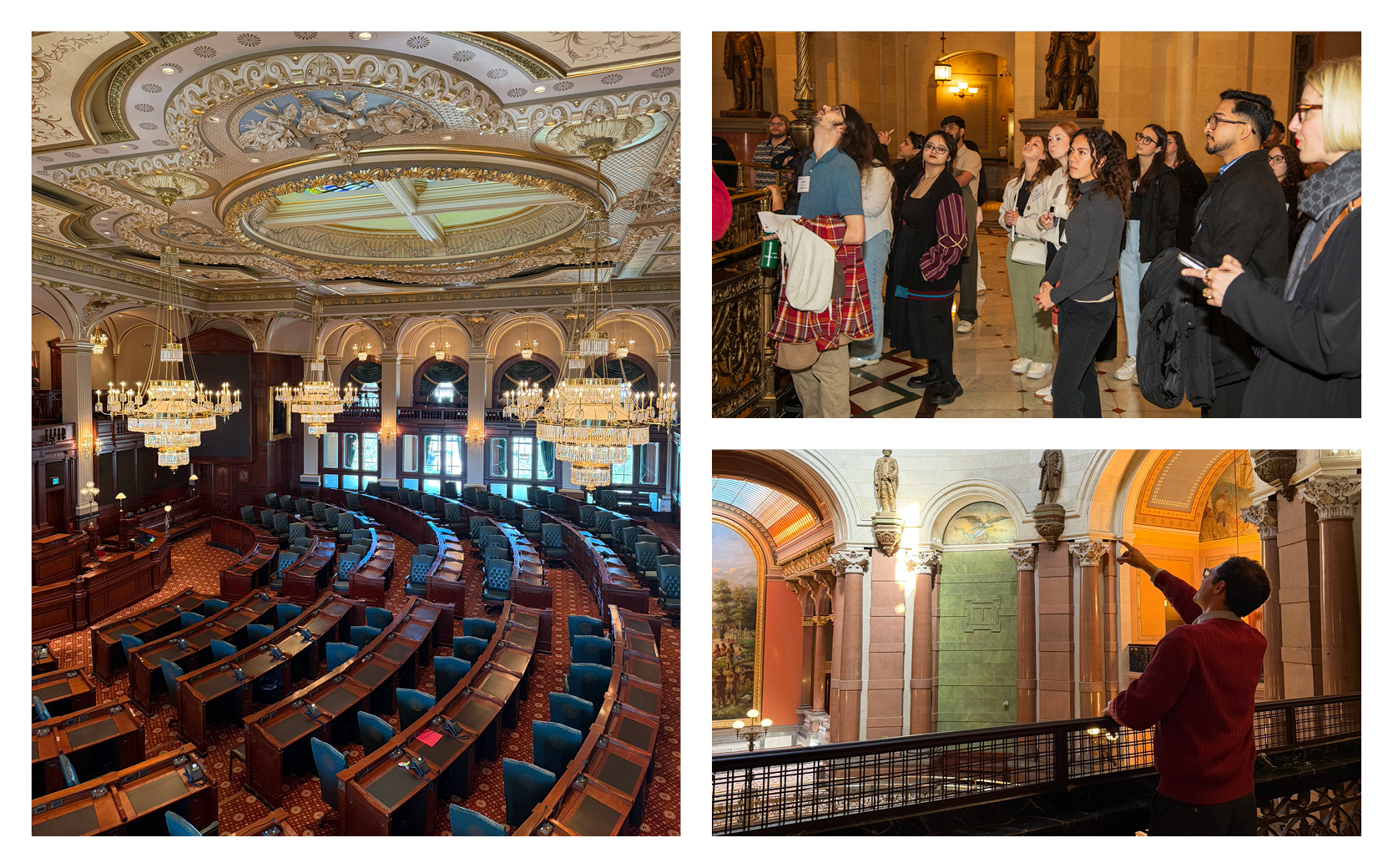
Descending into the basement revealed another layer of history, Roman-inspired construction techniques relying on compressive forces rather than steel, with massive piers absorbing gravity and lateral loads through arches. Above, the main rotunda centers on a stained glass state seal, while the attic space between the inner and outer domes was carefully designed for visual scale and experience. The east-west axis is intentionally wider, greeting the rising sun, while the north-south axis plays a secondary role. Portal architecture narrows views to heighten curiosity, pulling you forward toward something more compelling beyond, whether it’s a painting, space or moment of light.
Light itself becomes a design collaborator through clerestory windows placed high to capture both quality and quantity, allowing the building to shift with the time of day and season. Victorian sensibilities shine through in the deliberate use of color, with Tennessee marble, Missouri red granite and Italian marble selected for vibrancy rather than restraint. The dome’s zinc exterior, painted with aluminum, crowns it all, visible from miles away as a civic beacon.

The conference concluded with my session, Designing Your Career, a conversation I always find both energizing and grounding. Sharing my own path, including my transition from pursuing life as a violist to becoming an architect, is never about the pivot itself but about what it represents. Careers are rarely linear. They reward persistence, adaptability and a willingness to listen to change rather than resist it. For students standing at the threshold of practice, it’s often reassuring to hear that evolution isn’t failure, it’s growth, and that skills gained in one discipline often become the foundation for excellence in another.
Spending a weekend immersed in architectural history, civic symbolism and emerging student voices felt like a full-circle experience. From Wright’s obsessive attention to detail, to the Capitol’s embodiment of shared ideals, to conversations with students actively designing the next chapter of their own lives, I left Springfield reminded that architecture, at its best, is an act of leadership. It asks us to be intentional, to design with empathy and to build not just for today, but for the generations who will walk these spaces long after we are gone.
Lauren Chipman is the Chief Executive Officer of Chipman Design Architecture, where she provides creative leadership for one of the nation’s most established commercial architecture and design firms. A true multi‑disciplinary designer and former performing artist, Lauren brings an unconventional and forward‑thinking perspective to architecture, branding, and the built environment.
Before joining Chipman Design Architecture, Lauren built a successful career as a professional stringed instrumentalist, recording for television, film, and top Billboard artists. That background deeply informs her approach to design leadership today. Her ability to blend creativity with structure allows her to guide complex hospitality, retail, and restaurant projects with both vision and precision.
As a third‑generation leader of a family‑owned firm, Lauren is proud to carry on Chipman Design Architecture’s legacy while continuously pushing it forward. Under her leadership, the firm supports national and global brands including Chick‑fil‑A, Jeni’s Splendid Ice Creams, Ulta Beauty, and Whole Foods Market. Lauren’s entrepreneurial mindset extends beyond traditional architectural practice, emphasizing innovation, adaptability, and long‑term relevance.
Lauren actively integrates emerging technology into the conceptual design process and champions the recruitment of multi‑hyphenate talent with diverse professional backgrounds. By leveraging her experience as an industry outsider, she fosters a culture that values curiosity, inclusivity, and cross‑disciplinary collaboration. The result is a design practice that is both deeply experienced and future‑focused.


